
Website Orders To Northern Ireland & Republic Of Ireland and USA Now Available!


When people talk about a "standard" 20ft shipping container, they're referring to a globally recognised size that makes worldwide logistics possible. The external measurements are what really matter for transport and planning, and for a typical 20ft unit, you're looking at 20ft long, 8ft wide, and 8ft 6in tall.
In metric, that comes out to approximately 6.06 m by 2.44 m by 2.59 m. These figures aren't just random numbers; they're set by ISO 668 standards to ensure every container, no matter where it's made, fits perfectly onto lorries, trains, and ships. This standardisation is what allows for seamless compatibility at UK ports like Felixstowe and Southampton, as well as internationally.
For a more detailed breakdown, this table summarises all the key specs for a standard 20ft dry container. It's a handy reference with both imperial and metric values to cover all bases.
| Specification | Imperial (UK) | Metric |
|---|---|---|
| External Length | 20 ft | 6.06 m |
| External Width | 8 ft | 2.44 m |
| External Height | 8 ft 6 in | 2.59 m |
| Internal Length | 19 ft 4 in | 5.90 m |
| Internal Width | 7 ft 9 in | 2.35 m |
| Internal Height | 7 ft 10 in | 2.39 m |
| Door Opening Width | 7 ft 8 in | 2.34 m |
| Door Opening Height | 7 ft 6 in | 2.28 m |
| Cubic Capacity | 1,172 cu ft | 33.2 m³ |
| Tare Weight (Empty) | 4,850 lbs | 2,200 kg |
| Max Payload (Cargo) | 52,910 lbs | 24,000 kg |
| Max Gross Weight | 57,760 lbs | 26,200 kg |
These figures give you a clear picture of not just the outside footprint but also the usable space inside and the weight limits you need to work within.
Sometimes, a simple visual is the easiest way to get your head around the numbers. This infographic breaks down the core external measurements at a glance.
It highlights the consistent footprint and uniform height that are so crucial for stacking and transport. Of course, getting the container on-site is one thing, but making sure it's properly set up is another.
For tips on getting your container perfectly positioned, check out our guide on how to level a shipping container.
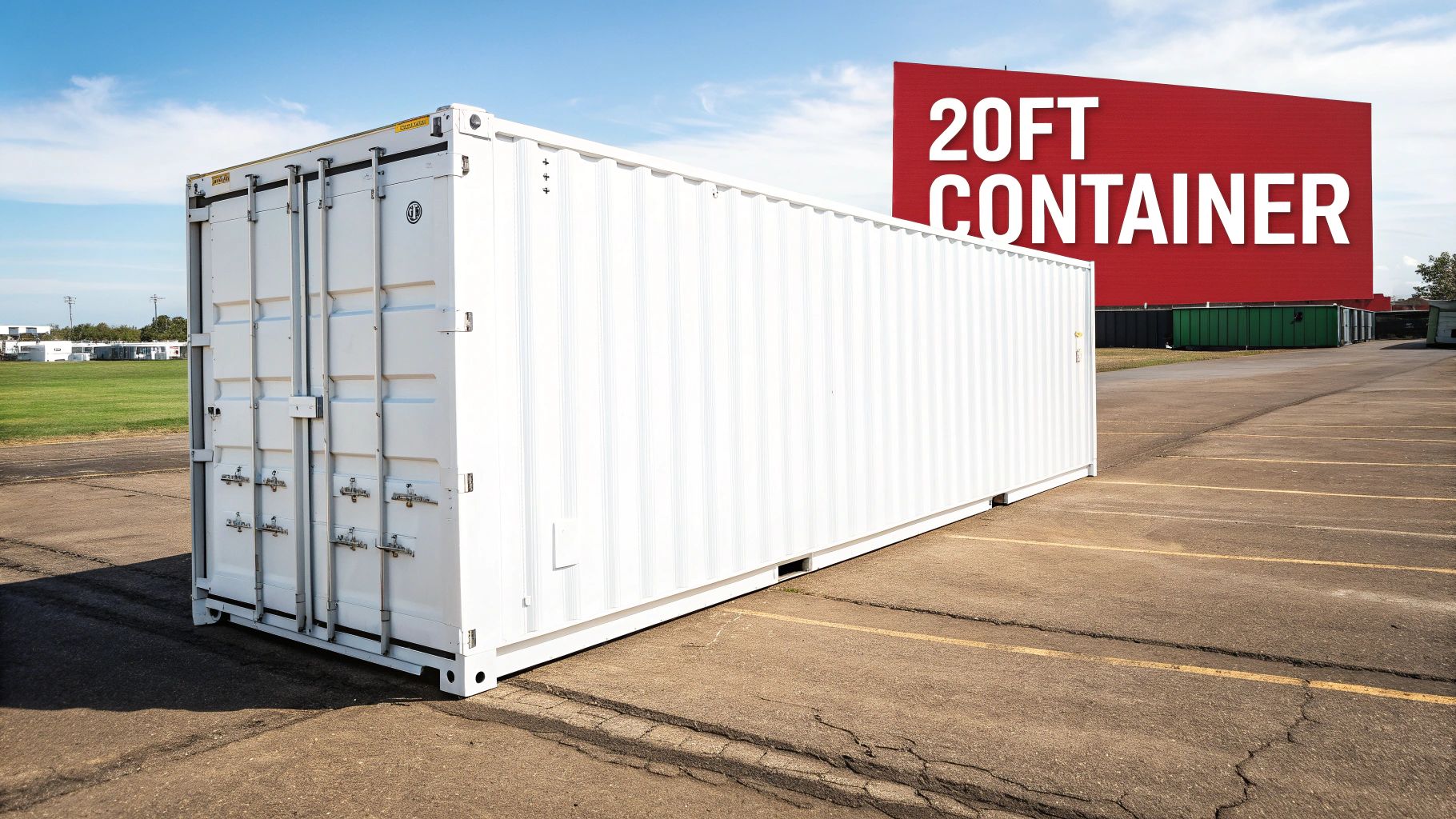
The incredible efficiency of global trade really boils down to one simple but powerful principle: standardisation. The external dimensions of a 20-foot shipping container aren't just random numbers; they’re meticulously defined by international agreements to guarantee universal compatibility.
This global uniformity is all thanks to ISO 668, the standard that dictates the precise external measurements. It's the reason a container from any manufacturer will fit perfectly onto any compliant lorry, train wagon, or ship, anywhere in the world. For UK logistics, this means seamless transitions from bustling ports to inland distribution networks without a hitch.
The official nominal dimensions you need to know are:
Now, while these figures are the gold standard, the manufacturing process always has a little wiggle room. These minor variations are known as tolerances. Don't worry, though – these small deviations are accounted for in the ISO standards, ensuring that even with slight differences, the core principle of interoperability is never compromised during transport.
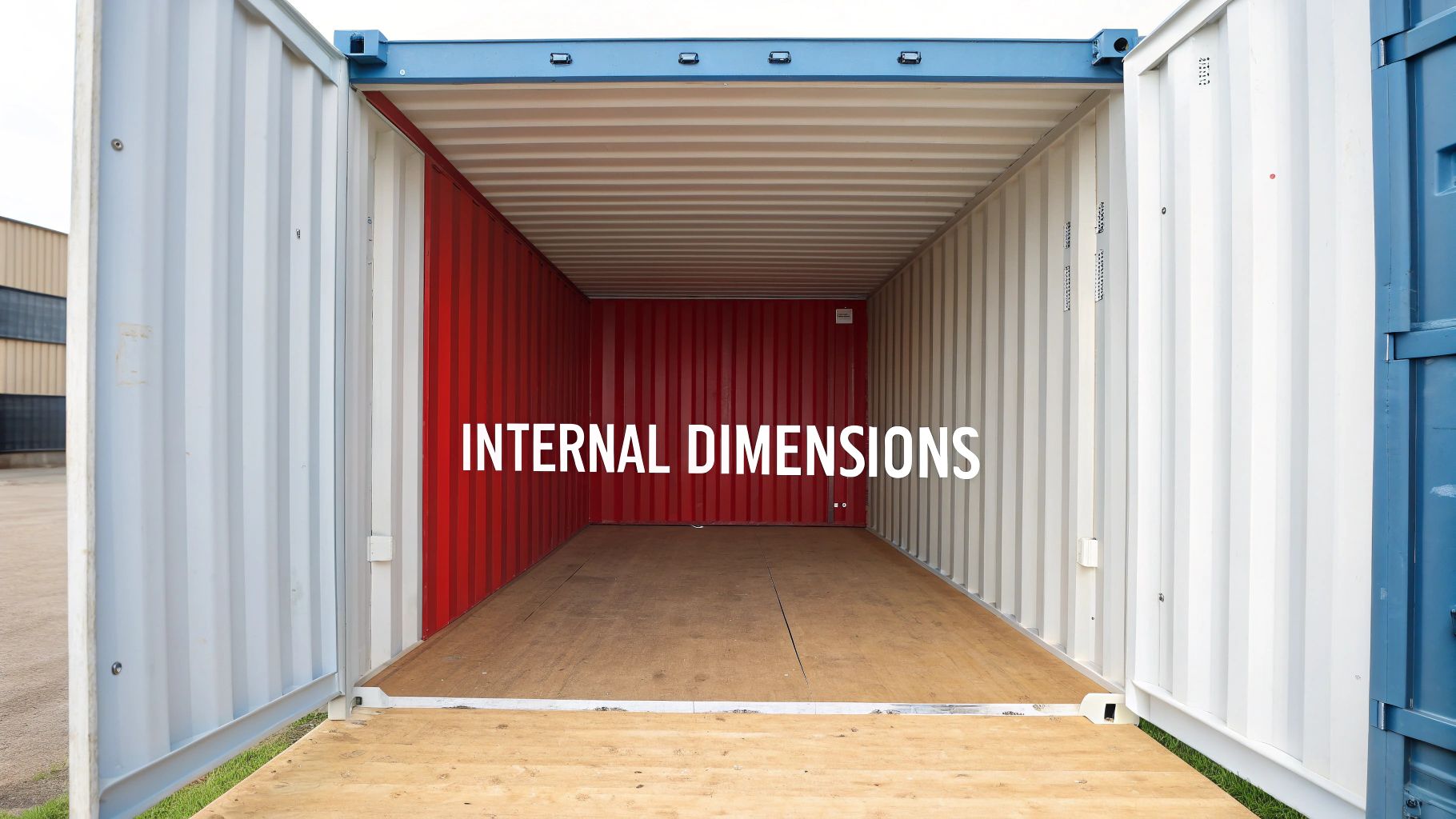
When you're planning to transport goods or start a container conversion project, it’s the internal space that really counts. While the external dimensions are crucial for logistics, the usable cargo space is determined by what’s inside.
The corrugated steel walls are essential for the container's structural strength, but they do take up a bit of room, slightly reducing the interior volume compared to the container's outer footprint.
A standard 20ft container gives you an internal length of about 19ft 3in (5.87m), a width of 7ft 7in (2.33m), and a height of 7ft 9in (2.35m). Crunching those numbers, you get a total internal floor area of around 150 sq ft (13.93 sq m).
This all translates to a total cubic capacity of roughly 1,172 cubic feet (33.2 cubic metres).
To put that into perspective, this is generally enough space to hold the entire contents of an average two-bedroom house during a move. For commercial stock, this volume can easily accommodate a significant amount of palletised goods or equipment, making it a seriously versatile choice for all sorts of applications.
While the physical dimensions of a 20ft container get a lot of attention, it's the weight specifications that are truly critical for safe and legal transport. Getting these numbers wrong can lead to serious headaches, from violating UK road regulations to breaching maritime safety protocols and exceeding equipment lifting limits.
Understanding these key figures is non-negotiable. They also play a direct role in how freight rates are calculated, so knowing your weights can save you money and keep your shipments moving smoothly.
There are three main weight figures you'll see on every container's CSC plate. Let's break down what they mean.
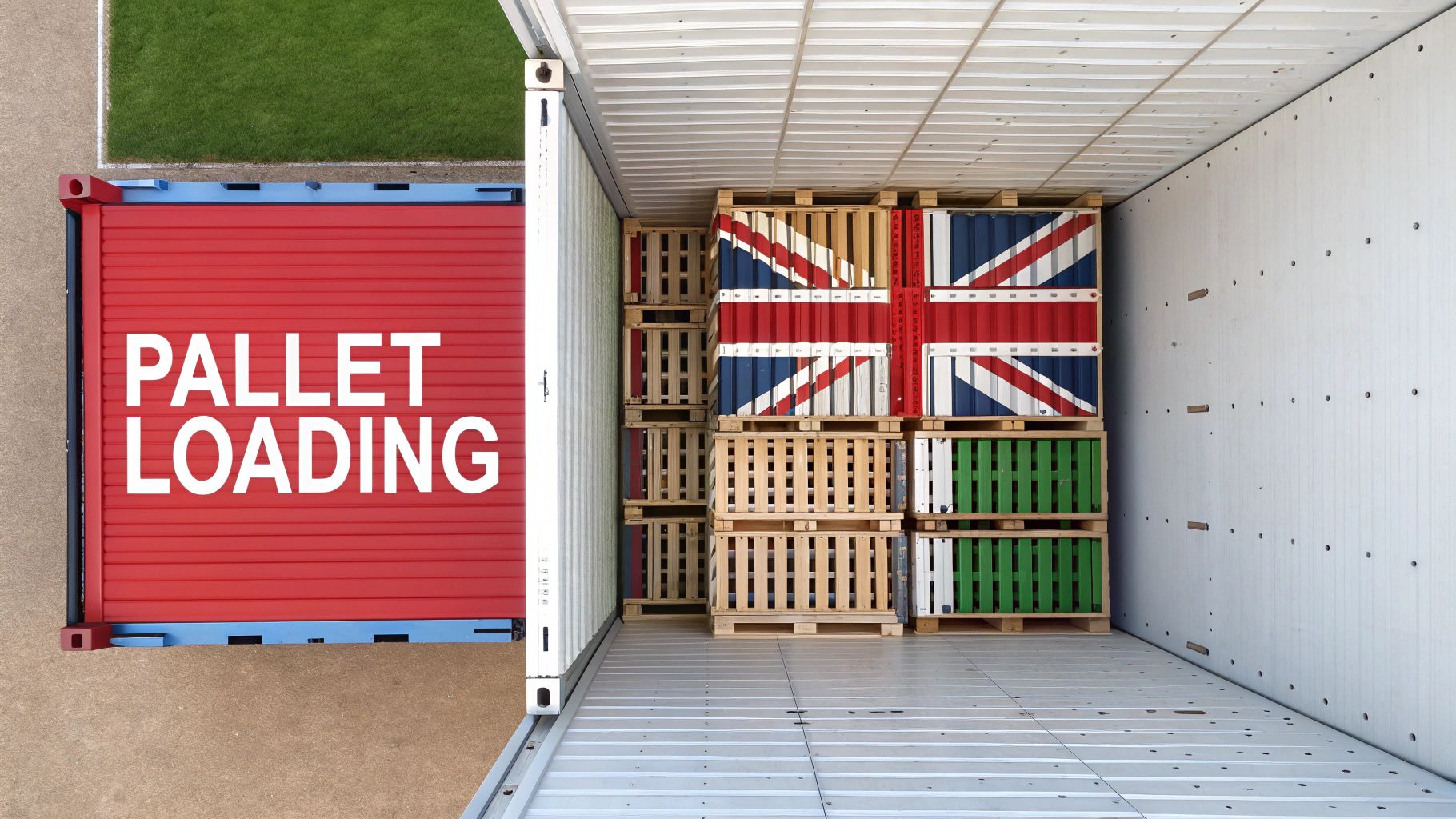
Knowing the raw dimensions of a 20ft shipping container is a great start, but the real art is in optimising your loading plan. For any UK business, loading pallets efficiently is a daily logistical challenge. A well-thought-out strategy is essential to prevent cargo from shifting during transit and to make sure you're not paying to ship empty air.
To get your internal layout right, you first need to get familiar with common standard shipping pallet sizes. The two you'll run into most often are the standard UK pallet and the Euro pallet. They have different dimensions, which directly impacts how many you can squeeze into a container.
When you're loading a 20ft container, the type of pallet you use makes a huge difference. UK standard pallets are wider, while Euro pallets are slightly smaller, which affects how they fit onto the container floor. This is especially important for businesses shipping goods into Europe, where the Euro pallet is king.
Here’s a quick breakdown of what you can expect to fit:
| Pallet Type | Dimensions (mm) | Max Pallets (Single Layer) |
|---|---|---|
| UK Standard Pallet | 1200 x 1000 | 9 - 10 |
| Euro Pallet | 1200 x 800 | 11 |
As you can see, the narrower Euro pallet allows you to fit one extra unit per layer. While it might not sound like much, that difference adds up quickly across multiple shipments. Arranging them correctly—often with a mix of lengthwise and widthwise placements—is the key to hitting that maximum capacity.
If you're shipping to the continent, knowing your container can hold 11 Euro pallets (1200 x 800 mm) per layer is a critical piece of information for planning. You can get even more out of this space with the right internal fittings. Take a look at our guide on shipping container shelving to maximise space for ideas on how to use the vertical space above your pallets.
While the standard dry van is what most people picture, the dimensions of a 20 foot shipping container often get tweaked to handle specialised cargo. You'll most commonly run into two particular variations: the High Cube and the Open Top container.
The High Cube (HC) container is a straightforward but incredibly useful modification. It adds an extra foot of vertical space, pushing the external height up to a full 9ft 6in. That extra clearance is a game-changer for transporting tall, bulky items that just wouldn't squeeze into a standard unit, giving you a significant boost in cubic capacity.
Just as the name suggests, open-top containers are built for cargo that's either too tall for even a High Cube or needs to be loaded by crane from above. They’re particularly popular across the UK for shipping oversized goods like machinery or building materials. They keep the standard external length and width but swap the solid steel roof for a removable tarpaulin cover, making top-loading a breeze.
Making sure you pick the right container type is crucial for any project. If you're weighing your options, our guide on buying storage containers is a great place to start.
When you're dealing with shipping containers, a few questions always pop up, especially when you're trying to figure out if a 20ft unit is the right fit for your project. Here are some straightforward answers to the queries we get asked most often.
While the external dimensions of a 20 foot shipping container are standardised across the globe thanks to ISO 668—which is essential for shipping compatibility—the internal measurements can vary slightly.
These minor differences, often just a few millimetres here and there, come down to things like the depth of the wall corrugation or the specific materials used by different manufacturers. If your cargo needs to fit with absolute precision, it’s always a good idea to double-check the exact internal specs with your supplier.
The price tag on a 20ft container can swing quite a bit depending on its condition (new or used), type, and what the market is doing at the time.
In the UK, hiring a container usually costs between £2 and £5 per day. If you're looking to buy, a used unit will typically set you back anywhere from £1,200 to £2,500, while a brand-new one could be in the range of £2,500 to £4,000. We always suggest getting a few quotes from reputable suppliers to find the best deal.
With roughly 33 cubic metres of space inside, a 20ft container holds more than you might think. It's generally big enough to store the entire contents of a standard two-bedroom house, which makes it a popular choice for removals.
From a commercial standpoint, you could comfortably fit a standard passenger car with room to spare. Or, if you're loading pallets, it will hold a full layer of 11 Euro pallets without any trouble.
For all your container modification and maintenance needs, Quickfit Container Accessories provides a huge range of high-quality parts, from shelving brackets to secure locking systems. Explore our online catalogue for reliable solutions delivered right to your UK site. https://www.quickfitcontaineraccessories.co.uk
{"one"=>"Select 2 or 3 items to compare", "other"=>"{{ count }} of 3 items selected"}