
Website Orders To Northern Ireland & Republic Of Ireland and USA Now Available!


Picking the right door for a shipping container isn’t a one-size-fits-all decision; it really comes down to what you’re using the container for. If you’re shipping goods across the globe, nothing beats the original cargo doors for security. But for a self-storage unit, you'll want the easy access of a space-saving roll-up door.
Think of your shipping container as a blank canvas. The door you pick is the first, and most important, brushstroke—it defines how you'll use and interact with the space inside. The wrong choice can lead to daily frustration, create security weak spots, or even let the weather in. Getting this right from the start is absolutely essential for any container project, whether it's for storage or a full conversion.
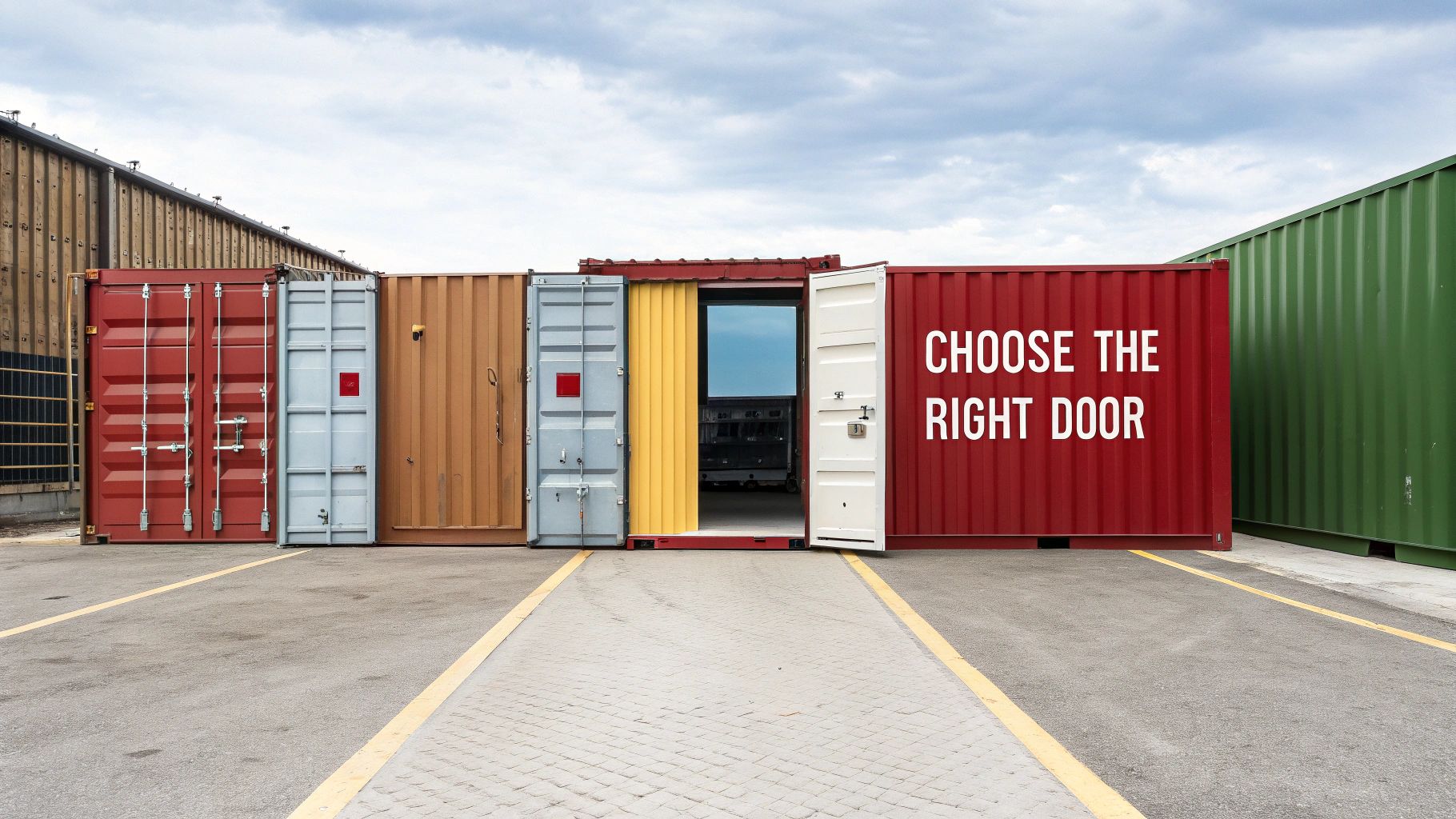
There are three main types of container doors, and each one is built for a specific job. Understanding what makes them tick is the first step to creating a setup that’s both functional and secure.
To help narrow it down, think about what your container's main job will be. Is ultimate security more important than quick access? Or is saving space a bigger priority than having a traditional entrance? This table gives you a quick summary to see which door type fits your project best.
When you're ready to move forward, working with a specialist UK supplier like Quickfit Container Accessories means you get the right parts and the expert advice needed to get the job done properly.
| Door Type | Best For | Key Feature | Consideration |
|---|---|---|---|
| Cargo Doors | Global shipping, secure static storage | Maximum security and weather resistance | Heavy and requires significant space to open |
| Roll-Up Doors | Self-storage, workshops, frequent access | Space-saving vertical operation | Offers less security than original cargo doors |
| Personnel Doors | Offices, accommodation, site welfare units | Convenient, everyday walk-in access | Requires precise cutting and welding to retrofit |
Each door has its trade-offs, but understanding them upfront will save you a lot of hassle down the line and ensure your container serves its purpose perfectly.
Picking the right door for a shipping container is about more than just getting in and out; it’s about defining what your container is for. The materials and design you land on will directly impact its security, day-to-day usability, and even the climate inside. It stands to reason that a door built for a rough sea journey has a completely different job to do than one on a pop-up café.
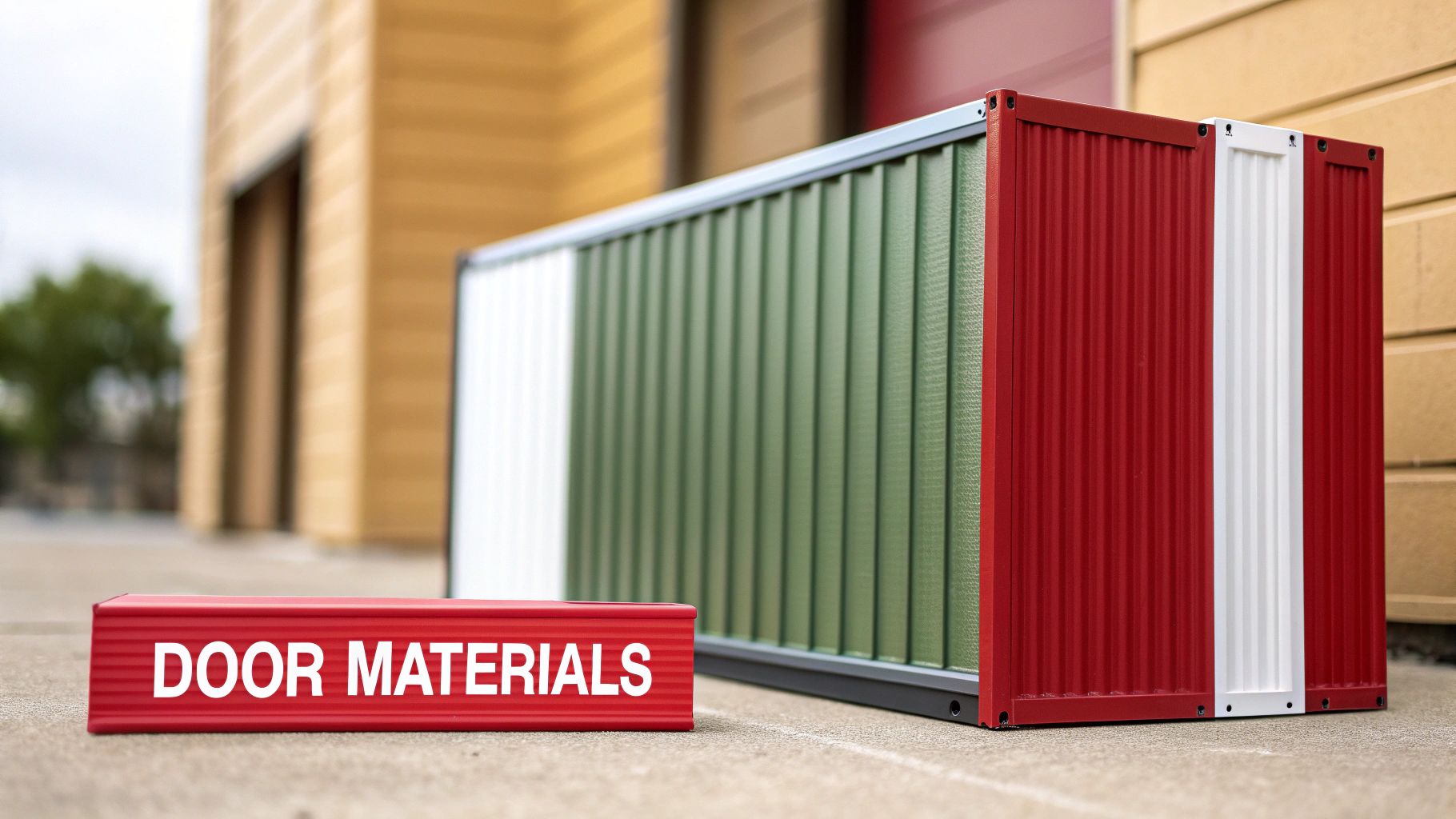
Here, we’ll break down the three main door types you'll come across. We’ll look at the materials and construction that make each one tick, so you can make a smart choice that fits your project perfectly, whether you need maximum security, space-saving efficiency, or just simple, everyday convenience.
Think of the original cargo doors as the container's built-in vault. These are the heavy-duty, double doors that come fitted as standard on one end of every shipping container straight from the factory. They’re constructed from thick, corrugated Corten steel for one reason: to survive the absolute worst conditions at sea, from corrosive salt spray to battering storms.
Their whole purpose is security and structural integrity. Kitted out with multiple heavy-duty locking bars, cams, and keepers that bite into the container's frame, these doors create a serious barrier against anyone trying to get in. This makes them the obvious choice for international shipping and for high-security static storage where the contents are valuable.
But all that strength comes with a trade-off. They are incredibly heavy, can be a real workout to open, and need a huge amount of clear space to swing fully open. For anything that needs frequent and quick access, they can be a bit of a nightmare. For sheer, brute-force strength, though, you can't beat them.
When every square inch of floor space counts, the roll-up door is a brilliant solution. You've seen them everywhere, from self-storage units to workshops. They operate vertically, coiling up neatly into a compact drum above the opening. This clever design completely gets rid of the need for swing clearance, meaning you can stack things right up to the entrance.
Roll-up doors are usually made from a lighter gauge steel than the original cargo doors, striking a good balance between security and ease of use. The thickness of the steel is the key thing to look at here, as it dictates both its strength and price.
While they'll never be as tough as the original cargo doors, a good quality roll-up door, paired with a solid lock, is a secure and highly practical access solution for tons of container conversion projects.
If you’re converting a container into an office, a site cabin, or living accommodation, a personnel door (or 'man door') is an absolute must. It’s what transforms an industrial steel box into a genuinely usable space, just like the front door on a house. These doors are designed for frequent, easy, walk-in access without the faff of heaving open heavy cargo or roll-up systems.
Personnel doors are typically built from galvanised steel for durability and rust resistance, but their real value is in the customisation options. You can specify features that boost comfort, security, and usability, turning a simple container into a proper, functional building.
A key feature to look for in a high-quality personnel door is an insulated core. A polyurethane foam core, for example, makes a massive difference to thermal efficiency. It helps keep the internal temperature stable and cuts down on condensation—a vital consideration in the UK's damp climate.
On top of that, you can seriously upgrade security with multi-point locking systems, which secure the door to the frame at several points instead of just one. This makes them far more resistant to being prised open. It's this combination of everyday convenience, insulation, and robust security that makes the personnel door the go-to choice for any container you plan to spend time in.
A shipping container is only as secure and dry as its door. You can pick the perfect door type, but its real-world performance boils down to two things: the lock that protects your gear and the gasket that keeps the relentless British weather out. Get either of these wrong, and you're looking at a serious security risk or thousands of pounds in water damage.
Think of these parts as the final line of defence for whatever you’re storing inside. The original heavy-duty cargo doors come with integrated locking bars, which are a great start, but they're only half the story. To properly fortify your container, adding external security isn't just a good idea—it's essential.
The factory-fitted locking bars on cargo doors are designed to clamp the door shut, using cam keepers to create a tight, secure closure. This is fine for transit, but for static storage, they need some backup. This is where a high-security lockbox comes in.
A lockbox is a thick steel housing welded directly onto the container doors. It acts as a protective shroud around a padlock, making it incredibly difficult for thieves to get at it with bolt cutters or grinders. Pair it with a quality shrouded padlock, which has almost no shackle exposed, and you've created an exceptionally tough barrier to break. To dive deeper into picking the right security, check out our detailed guide on choosing the best locks for shipping containers.
For personnel and roll-up doors, the approach is different, but just as critical.
If you’re securing a business or storage container, it's worth looking into specialised commercial locksmith services. They can offer advanced locking solutions tailored to your exact needs.
While locks protect your container from people, gaskets protect it from nature. That black rubber seal running along the inside edge of the cargo doors is the only thing stopping water from getting in. This isn't just any old rubber; it's typically made from EPDM (Ethylene Propylene Diene Monomer), a synthetic rubber loved for its incredible resistance to weathering, ozone, and extreme temperatures.
Here in the damp UK climate, a fully functional gasket is non-negotiable. When the doors are locked, it creates a compressive, watertight seal that stops rain, sleet, and condensation from creeping inside and causing mould, rust, and irreparable damage.
Over time, though, even the toughest EPDM gaskets give up the ghost. Constant UV exposure, temperature swings, and the physical stress of opening and closing heavy doors will eventually make them brittle, cracked, or permanently compressed. Once a gasket loses its flex, it can no longer form a perfect seal, and your container is left vulnerable.
This wear and tear is massively sped up by the sheer volume of traffic passing through UK ports. Recent figures show that in the third quarter of 2025, UK container tonnage surged by 43% to 19.5 million tonnes year-on-year. This boom, led by facilities like the Port of London which saw an 88% rise in tonnage, means millions of door openings annually, subjecting seals and locks to immense mechanical stress and corrosion. With thousands of container ships calling at UK ports, ensuring every door has a perfect seal is vital for protecting the 76 million tonnes of cargo transported yearly. Discover more insights about UK port freight statistics on the government's official page.
Checking your gaskets regularly for signs of wear and replacing them at the first hint of damage is a simple but vital bit of maintenance. It's a small investment that pays for itself many times over by protecting your container and everything inside it.
Fitting a new door is one of the most common and effective ways to transform a shipping container. A simple steel box suddenly becomes a functional, accessible space, whether it’s a site office that needs a convenient personnel door or a workshop that could do with a space-saving roll-up door. The job demands a bit of precision and the right approach, but with the correct tools and a clear plan, you can get a professional, weatherproof finish that seriously upgrades your container's usefulness and security.
This guide will break the process down into simple, manageable steps. From the all-important first measure to the final touches of sealing and painting, we'll walk you through the entire installation and point out the common pitfalls so you can avoid making costly mistakes.
Before you even think about cutting into that steel, meticulous preparation is everything. The old saying "measure twice, cut once" has never been more true. One bad cut can compromise the container's structural integrity, leaving you with a door that won't fit, seal, or lock properly.
Start by carefully unboxing your new door and its frame. Use the frame's exact external dimensions to mark the cutout area on the container wall. A spirit level and a marker pen are your best friends here. Don't forget to factor in the container's corrugated walls; the frame needs to sit flush against the outer surface to get a solid weld and a weatherproof seal.
Pro Tip from Quickfit: When you're marking up, it's always a good idea to make the initial opening a fraction smaller than you need. You can always grind a little more steel away to get that perfect, snug fit, but you can't put it back once it's gone. This simple precaution saves you from the classic mistake of an oversized hole, which results in weak welds and a leaky seal.
With your lines marked, it's time to create the opening. The tool you pick will depend on your budget, your experience, and the kind of finish you're after.
No matter which tool you use, always wear the right personal protective equipment (PPE). We're talking safety glasses, gloves, and ear defenders. Cutting steel creates a lot of sparks and leaves razor-sharp edges, so safety has to be your number one priority.
Gathering the right kit before you start is half the battle. Here's a quick checklist of what you'll need to get a new personnel door fitted correctly.
| Tool/Material | Purpose |
|---|---|
| Spirit Level | Ensuring the door frame is perfectly level and plumb before welding. |
| Marker Pen | Accurately marking out the cutting lines on the container wall. |
| Angle Grinder / Plasma Cutter | Cutting the aperture for the door frame. |
| Welder (MIG or Stick) | Securely welding the door frame to the container's steel wall. |
| Clamps and Shims | Holding the door frame in the perfect position for welding. |
| Grinding Discs / Flap Discs | Smoothing the cut edges and finishing the welds for a clean look. |
| PPE (Gloves, Goggles, Mask) | Essential personal protection from sparks, metal shards, and fumes. |
| Zinc-Rich Primer | Protecting the raw, cut steel from rust and corrosion. |
| Durable Metal Paint | The final weatherproof and cosmetic coating for the frame and welds. |
Having these items ready to go will make the entire process smoother and help you achieve a professional-looking, long-lasting installation.
Once the hole is cut and the edges are ground smooth, it's time to get the door frame in. Position it carefully within the opening, using clamps and shims to hold it perfectly level and plumb. It's a good idea to tack weld it in a few spots first before you commit to welding the whole thing.
Weld the frame securely all the way around the perimeter. You're aiming for a continuous bead to create a bond that's both strong and completely waterproof. This is a critical step for security and for keeping the weather out. Afterwards, grind the welds down for a clean, professional finish.
The final, and absolutely crucial, step is to treat all the exposed metal. Any raw steel edge—from the cut or the weld—will start to rust almost immediately. Get a high-quality, zinc-rich primer on there, followed by a durable metal paint to protect your handiwork from the elements.
This diagram shows the key security elements that make a container door so tough.
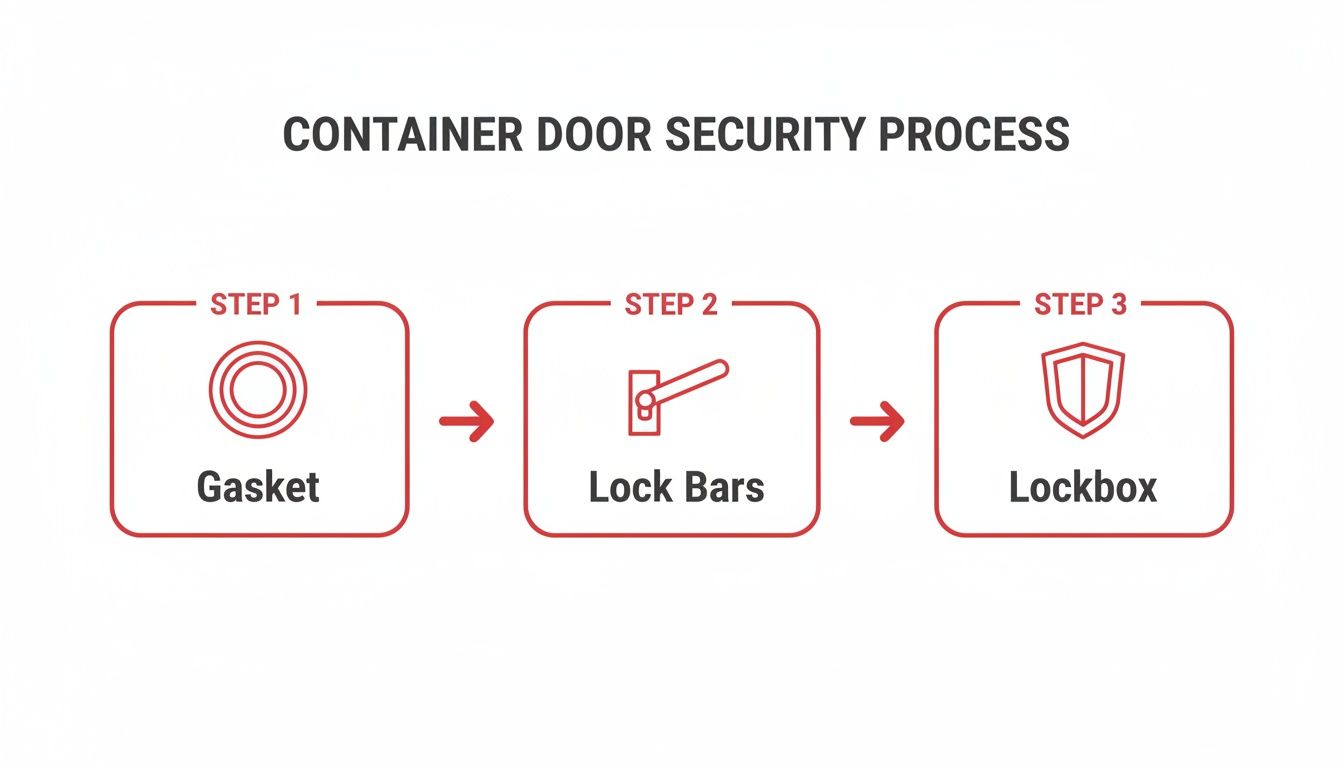
It’s a multi-layered system: the gasket keeps it weathertight, the lock bars provide the brute strength, and a lockbox shields the padlock from attack.
Finally, hang the door, install the locks, and double-check that you have a perfect seal all the way around. If you need any specific hinges, handles, or other bits and pieces, you can find what you need in our full range of shipping container door components.
Proper maintenance is the secret to a long-lasting, reliable door for a shipping container. Just like any bit of kit that faces the elements, a little TLC goes a seriously long way. Think of it as a quick, seasonal checklist that saves you from costly repairs and the sheer frustration of a door that won't budge.
These routine checks are especially vital in the UK’s damp climate, which can speed up rust and cause moving parts to seize up. Taking just a few minutes every few months to look after your door will protect your investment and keep your container secure and dry.
To keep everything working as it should, you only need to focus on three key areas: lubrication, gasket care, and rust prevention. These simple actions tackle the most common points of failure and are easy for anyone to do.
Sometimes, a stiff or wonky door isn't the door's fault at all—it's the ground underneath. If a container isn't sitting perfectly level, the whole frame can twist just enough to make the locking bars bind. If you find the door is a pain to operate, check that the container is level and use levelling pads to make adjustments. This simple fix often sorts the problem without you having to touch the door itself.
A well-maintained door isn't just about convenience; it's a critical security feature. This is particularly true for the UK's booming self-storage sector, which now includes over 1,135 container-based sites. These doors endure thousands of cycles yearly, and a failure can lead to security breaches or weather damage for customers who rely on 24/7 access. For the full picture on this trend, discover more insights from the 2025 SSA UK Report.
To keep your container door working like a dream for years to come, using a comprehensive door maintenance checklist can give you a solid routine to follow. It’s the best way to safeguard your assets and ensure hassle-free operation.
Choosing the right door for a shipping container is that final, crucial piece of the puzzle. It’s the step that brings your entire project together.
By now, you’ve got a handle on how your specific plans, security needs, and day-to-day access requirements point you towards the best door—whether that’s a heavy-duty original cargo door, a slick roll-up, or a simple, practical personnel door. Making that final choice with confidence often comes down to one thing: working with a specialist who genuinely gets the ins and outs of container conversions.
This is where partnering with a dedicated UK supplier like Quickfit Container Accessories really pays off. Instead of trying to figure it all out on your own, you get access to proper technical support over the phone. Any questions about installation or which part fits what are answered quickly and correctly, which is vital for getting that secure, professional finish your project deserves.
We’ve set things up to make finding and ordering the exact components you need as straightforward as possible. Whether you're in the middle of a full-blown conversion or just carrying out some essential maintenance, we have the resources to back you up.
Choosing a specialist supplier means you’re not just buying a product; you’re gaining a partner. You get the assurance of quality parts backed by a team that understands the unique challenges of working with shipping containers in the UK climate.
Ready to find the perfect fit for your project? You can explore our extensive online catalogue to find the ideal shipping container doors and windows.
And if you’re tackling something a bit more complex or just need some tailored advice, our support team is ready to help you get moving.
When you're dealing with doors for shipping container projects, a few questions always pop up. Whether it's about fitting, security, or just keeping things running smoothly, getting clear answers is key. We've pulled together the most common queries we hear to help you get your project sorted with confidence.
This is a big one. While it’s tempting to go the DIY route, fitting a personnel door isn't a simple weekend job. It takes some serious kit—think plasma cutters and welding gear—and a very steady hand. Cutting through corrugated steel without warping it requires real precision.
Honestly? We nearly always recommend getting a professional fitter. They'll guarantee the frame is welded in perfectly square, flush, and level, creating a completely weatherproof seal. It’s the difference between a door that works flawlessly for years and one that’s a constant headache. If you're set on doing it yourself, our downloadable Container Handbook and our team on the phone can offer some solid guidance.
For pure, brute-force security, you simply can't beat the original steel cargo doors that come with the container. They're built like a tank. Their heavy-duty construction and multiple locking points make them a nightmare for anyone trying to break in.
Add a high-quality, welded steel lockbox and a hefty shrouded padlock to the mix, and you've got a fortress. However, if you're modifying a container for regular use, like a site office or workshop, a high-spec steel personnel door with a multi-point locking system is a fantastic alternative. It gives you that brilliant blend of robust security and day-to-day convenience.
A sticking container door is almost always down to one of two things. First, and most commonly, the container isn’t sitting on perfectly level ground. Even a slight twist in the container's structure is enough to throw the door frame out of alignment. Popping some dedicated levelling pads under the corners usually sorts this out straight away.
The second culprit is simple neglect. The hinges and locking bars can seize up with rust and grime over time. A good dose of quality, marine-grade grease on all the moving parts will keep everything operating smoothly. It's a quick maintenance job that makes a world of difference.
At Quickfit Container Accessories, we've got everything you need to secure, maintain, and upgrade your shipping container. From high-security lockboxes to durable EPDM gaskets, our online catalogue is packed with solutions. Explore our full range and get next-day UK delivery at https://www.quickfitcontaineraccessories.co.uk.
{"one"=>"Select 2 or 3 items to compare", "other"=>"{{ count }} of 3 items selected"}