
Website Orders To Northern Ireland & Republic Of Ireland and USA Now Available!


So, you've got a shipping container and a spot to put it. The big question is, do you need planning permission? In the UK, the answer is nearly always a classic: it depends.
It all boils down to what you’re doing with it, where it’s going, and for how long. A container dropped on a building site for a few months is a world away from one you’re turning into a permanent workshop in your back garden.
Figuring out if you need the council’s blessing comes down to a few key things: how permanent it is, its size, where you're putting it, and its purpose. Don’t think of it as a simple 'yes' or 'no'. It's more like a checklist that points you in the right direction.
For a lot of temporary or minor uses, your container might fall under “permitted development rights.” This is essentially a pre-authorised green light from the government that means you can skip the full planning application. But—and this is a big but—it’s not a free pass. It all hangs on your specific situation.
Get a grip on what triggers the need for planning permission, and you'll have a much clearer idea of where you stand. When your local planning authority looks at your container, here’s what they’ll be thinking about:
As a rule of thumb, the more permanent, visible, and disruptive your container is, the more likely you are to need formal planning permission.
If you want to dive deeper into the general rules, this guide is a great place to start: Do I Need Planning Permission in the UK?. It gives a solid overview of the principles that apply to all sorts of projects.
Think of Permitted Development Rights (PDR) as a set of pre-authorised works you can carry out without needing to file a full planning application. For shipping containers, these rights can be a huge help, but everything hinges on one crucial distinction: is your container a temporary object or a permanent building?
The answer usually boils down to how long the container will be on-site. In the UK, placing a container on your land is often judged on whether it’s seen as a temporary structure or a permanent fixture. Luckily, PDR offers a key shortcut.
Under Class B of Part 4 of the General Permitted Development Order (GPDO), you can place a shipping container on your land for up to 28 days without planning permission. However, this is only allowed once per calendar year and can’t be within the curtilage (the immediate land associated with) a building. For a deeper dive, the folks at Planning Geek have some great insights.
This “28-day rule” is the cornerstone of temporary use. Imagine you're a construction manager who needs secure storage during a two-week project – this rule is perfect. But if that project overruns and the container stays for two months, you’ve crossed the line and will likely need planning permission.
This decision tree shows the basic questions a planning officer might ask when figuring out if your container falls under permitted development.
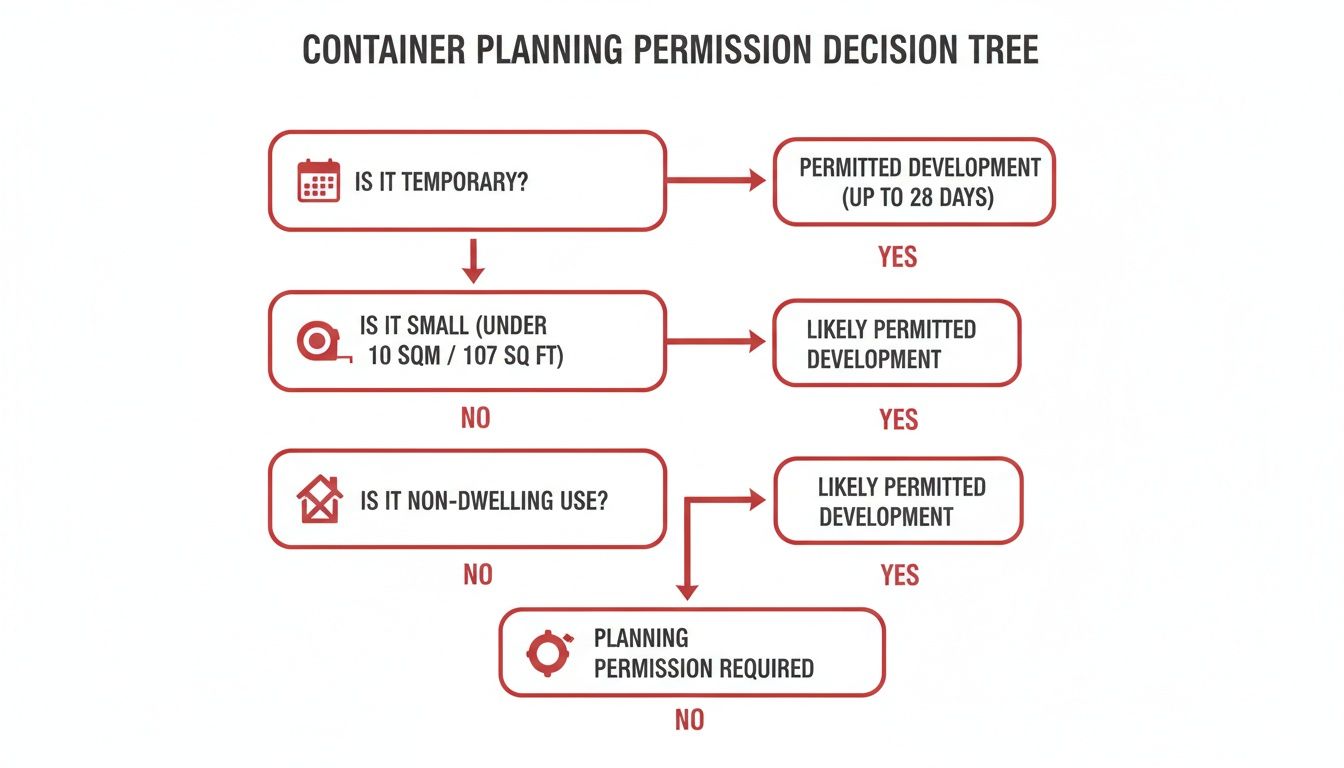
The key takeaway? Keeping your container temporary, small, and for non-residential purposes is the clearest path to staying off the planning department’s radar.
So, how do you make sure your container is genuinely seen as temporary and not some stealth building project? It’s all about ensuring it remains an object that can be easily moved, not something physically fixed to the land.
This is where the right accessories make all the difference. Instead of pouring a permanent concrete slab, using simple levelling pads shows the installation isn’t fixed. Similarly, using a freestanding ramp for access, rather than building a permanent decked entrance, reinforces its temporary nature.
By definition, a temporary structure is one that is not permanently fixed to the ground. Using non-permanent accessories like lockboxes, bolt-on shelving, and movable ramps helps maintain this status in the eyes of a planning authority.
Let’s look at a couple of real-world examples:
These small choices signal your intent and can be the deciding factor in whether your project flies under the radar or gets flagged for a full-blown planning application.
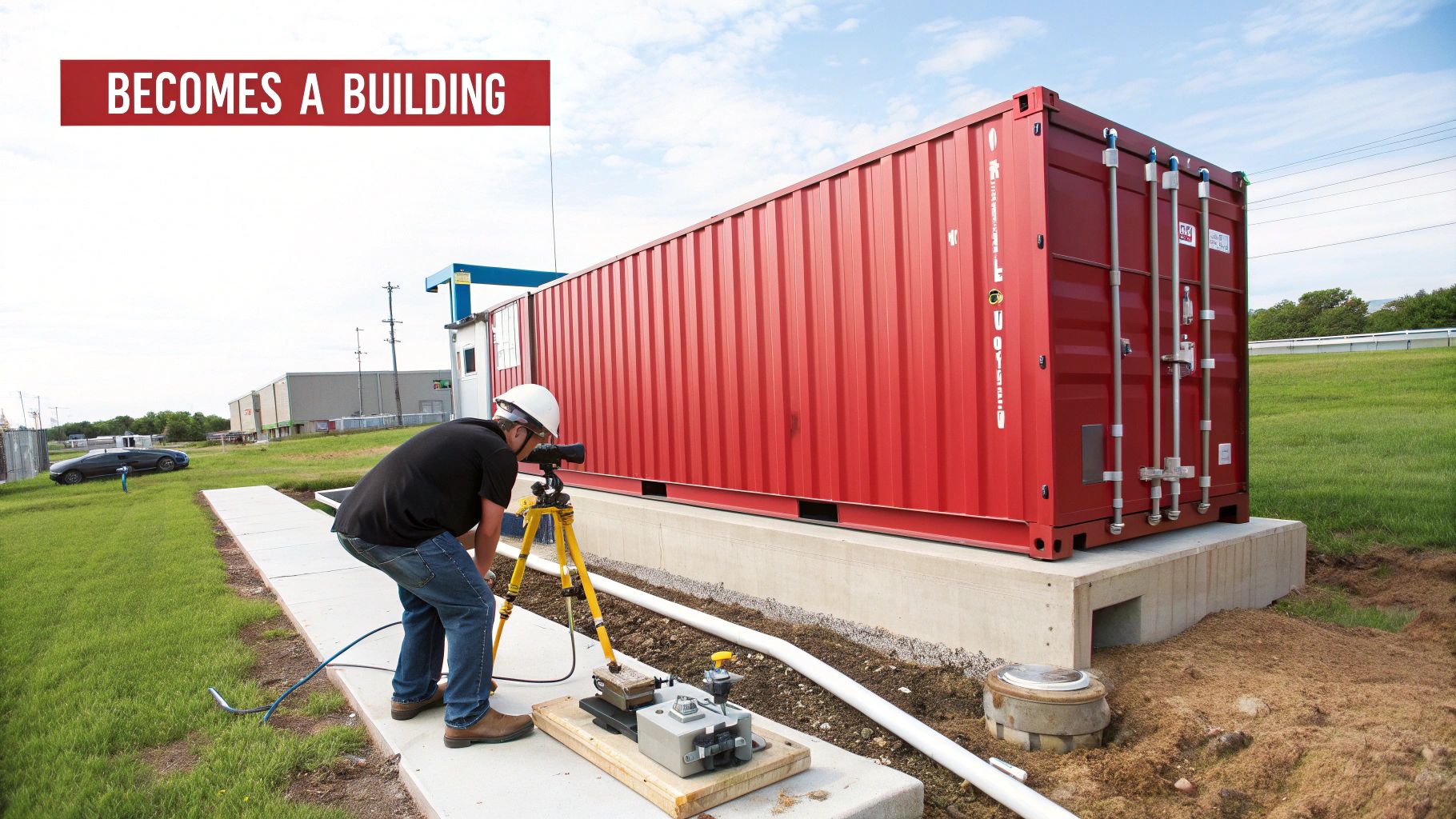
There’s a clear line in the sand where a shipping container stops being just a simple, moveable box and legally becomes a ‘building’ in the eyes of UK planning law. This distinction is everything when you're trying to figure out if you need planning permission for a shipping container. Getting this right from the start is the key to avoiding a headache with your local council down the line.
Think of it like the difference between a touring caravan and a static home that’s plumbed into the mains. One is clearly temporary and mobile; the other is permanent. For containers, the legal test boils down to whether the structure has a certain size, is permanent in nature, and is physically attached to the land.
Under the Town and Country Planning Act 1990, the legal definition of a 'building' is pretty broad, covering "any structure or erection". This means a shipping container can absolutely be classed as a building if it shows a high enough degree of permanence.
Once your container makes this shift from a temporary object to a permanent structure, it triggers the need for a full planning application. It also drags Building Regulations into the picture, which are the rules governing construction standards for things like safety, insulation, and energy efficiency.
So, what exactly pushes your container across this legal boundary? Planning authorities will look at a few key things to decide its status. If your container setup ticks any of these boxes, it's almost certain they'll see it as a building.
At the end of the day, the more you attach it to the ground and hook it up to services, the more certain it is that you’ll need to put in a planning application. This is especially true for anyone running a self-storage business or for maintenance teams planning to leave a container on-site for the long haul.
Just when you think you’ve got a handle on Permitted Development Rights, the rules can completely flip depending on where you are. These rights aren't a universal golden ticket; they often evaporate the moment your land falls within a specially protected or designated area. Getting your head around these location-specific restrictions is absolutely critical before a container even touches your property.
Your first port of call should always be your Local Planning Authority (LPA). They are the final arbiters, and it’s their interpretation of the rules that truly counts. What might be perfectly acceptable on a generic industrial estate will almost certainly be shot down in a sensitive landscape without a rock-solid justification and a formal application.
Certain spots in the UK are under much tighter planning controls to protect their unique character, natural beauty, or historical significance. If your property is in one of these zones, you should work on the assumption that almost any development—including siting a shipping container—will require full planning permission.
These designated areas typically include:
While many container projects on private land might not need permission if they’re temporary and don't cause a fuss, these exemptions vanish in protected zones. In an AONB, National Park, or near a listed building, even a single container almost always demands formal approval.
It’s a common and costly mistake to assume permitted development rights apply everywhere. For businesses eyeing up a container for a rural or historically significant spot, this due diligence isn't just a good idea—it's non-negotiable. Enforcement action in these areas is often swift and strict.
Before you even think about ordering a container, you need to verify the rules with your LPA. It’s a simple step that can save you a world of financial and legal pain down the line. Most council websites have interactive maps where you can punch in your postcode and see if your property falls within any of these designated areas.
When you're dealing with designated areas and local council rules, be aware that other practical requirements can also become a critical part of your application, particularly in rural settings. For example, you might need to show how you plan to install land drainage to manage surface water. Putting in a well-prepared enquiry or a pre-application can clear up these points early on. Proving your container won't harm the local character is the name of the game if you want to get approval in these sensitive locations.
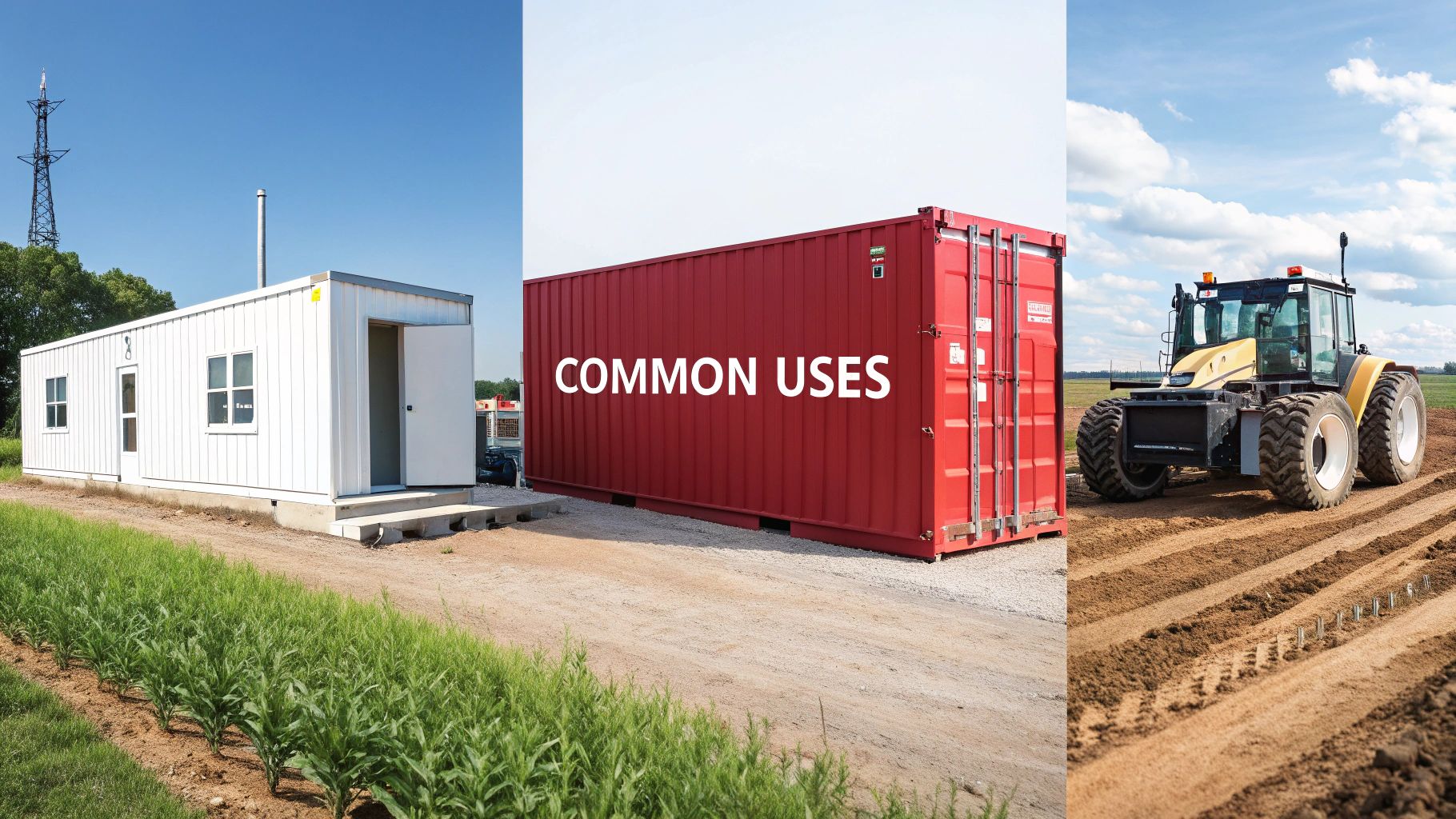
Theory is one thing, but seeing how these planning rules play out in the real world is where it all clicks. Let’s walk through three common scenarios to get a feel for when and why you need planning permission for a shipping container.
You'll quickly see that the context is everything. What you plan to do with the container is the single biggest factor determining whether the council will get involved, from a temporary office on a building site to a permanent fixture on a farm.
Imagine a site manager running a six-month building project. They need a temporary office and a secure spot to lock up tools. A container is dropped within the site boundary, isn’t hooked up to mains utilities, and is earmarked for removal the moment the job is done.
In this situation, planning permission is very unlikely to be needed. The container's use is directly tied to the construction work, which already has the green light. It falls neatly under the category of temporary buildings needed to support the main development.
An entrepreneur spots an opportunity and decides to set up a self-storage business using 30 shipping containers. They lease a plot of land, plan to arrange the containers in neat rows, and connect the site to electricity for lights and security cameras. This is a full-blown commercial operation.
This is a clear-cut case where planning permission is definitely required. We’re not talking about a minor, temporary addition here. This is a commercial enterprise that represents a material "change of use" for the land. The council will want to look closely at everything from visual impact and traffic flow to the effect on neighbouring homes and businesses.
A commercial self-storage facility is a textbook example of when a full planning application is non-negotiable. The number of containers and the permanent business operation mean it has zero chance of falling under permitted development.
Even though the individual containers aren't bolted to the ground, the business itself is permanent. If you're thinking on a smaller scale, our guide on using a shipping container as a garage has some useful tips for personal storage projects.
A farmer needs a dry, secure place to store vital equipment and animal feed. They want to place a container on their land, tucked away near an existing barn and out of public view.
Now, this is where things get a bit more nuanced. Under permitted development rights for agriculture, farmers can often install buildings that are "reasonably necessary for the purposes of agriculture" without needing a full planning application, as long as they meet certain size and location rules.
Right, so you’ve got a handle on the rules. Now, how do you actually navigate the planning system without tearing your hair out?
It can feel a bit like wading through treacle, but if you break it down into a few common-sense steps, the whole process becomes much clearer. Let's walk through it.
First things first, do a quick self-assessment. Run through the checklist in your head based on what we've already covered: permanence, size, location, and what you’re using it for.
Is it genuinely temporary and easy to move? Is it tucked away out of sight and not in a designated area like an AONB? And is its use just incidental to your main property – like storing garden tools? A bit of honest reflection here will give you a pretty good gut feeling for whether you can skip the formal application and rely on permitted development.
If that initial check leaves you with any doubts, or it looks like you probably do need permission, your next move is to get in touch with your Local Planning Authority (LPA). Every council has a planning department, and their website is your best starting point. Most have handy interactive maps you can use to see if your property falls into any specially designated areas.
But before you even think about lodging a full application, look for the council's pre-application advice service. Seriously, this is one of the most useful tools at your disposal. For a small fee, you can have an informal chat with a planning officer, show them what you’re thinking, and get their professional opinion on your chances of success. They’ll often point out potential issues you hadn't even considered.
"Engaging with pre-application advice is one of the most effective ways to de-risk a planning application. It allows for an open dialogue with the council, helping you refine your proposal before committing to the full cost and effort of a formal submission."
Whether you're going for pre-application advice or a full-blown submission, you'll need to have your information ready. Being organised at this stage makes a massive difference and shows the council you're serious.
You’ll typically need:
Proper groundwork is also a big part of a compliant and stable installation. Getting this right can even help support the argument that the container is temporary. You can learn more about the best practices for ensuring your shipping container is level in our detailed guide. It's a small step that can save a lot of headaches later on.
Even with the rules laid out, a few specific questions always seem to pop up. Let's tackle some of the most common ones we hear about needing planning permission for a shipping container.
Thinking of using a shipping container for living accommodation? That's a big project. Legally, it’s seen as a material ‘change of use’ to a residential dwelling.
This kind of transformation will almost certainly need full planning permission. On top of that, it will have to meet strict Building Regulations for habitability, covering everything from insulation and fire safety to ventilation and structural integrity. Permitted development rights simply don't apply when you're creating a new, separate home in your garden.
Ignoring the rules is a risky game that can end badly. If you skip getting planning permission when it’s needed, your local council can issue an enforcement notice.
This is a legal order demanding you remove the container from your land. Fail to comply, and you could be facing hefty fines or even prosecution. It's always far better to get any planning issues sorted out from the start.
It's a dangerous strategy to just hope you won't get caught. The 'immunity period' before a council loses its right to take enforcement action is now 10 years for most planning breaches. This problem won't just go away on its own.
If your container falls under permitted development, you’re under no legal obligation to inform your neighbours. That said, a friendly heads-up is usually a good idea. It helps keep relations smooth and can stop potential misunderstandings before they start.
However, if your project needs a full planning application, the situation is different. Your local planning authority will formally consult your neighbours as a standard part of the process, giving them a chance to view and comment on your plans.
Navigating the rules around planning permission is easier when you have the right equipment to keep your container temporary and functional. Quickfit Container Accessories offers everything you need, from levelling pads and ramps to secure lockboxes and ventilation, all with next-day UK delivery. Equip your container for compliance and convenience by visiting https://www.quickfitcontaineraccessories.co.uk.
{"one"=>"Select 2 or 3 items to compare", "other"=>"{{ count }} of 3 items selected"}